Chapter 1: The Ad Shift: Where Discovery and Dollars Move Next

Table Of Contents


What the Data Shows
1. Discovery: Where Shoppers First See and Respond to Ads
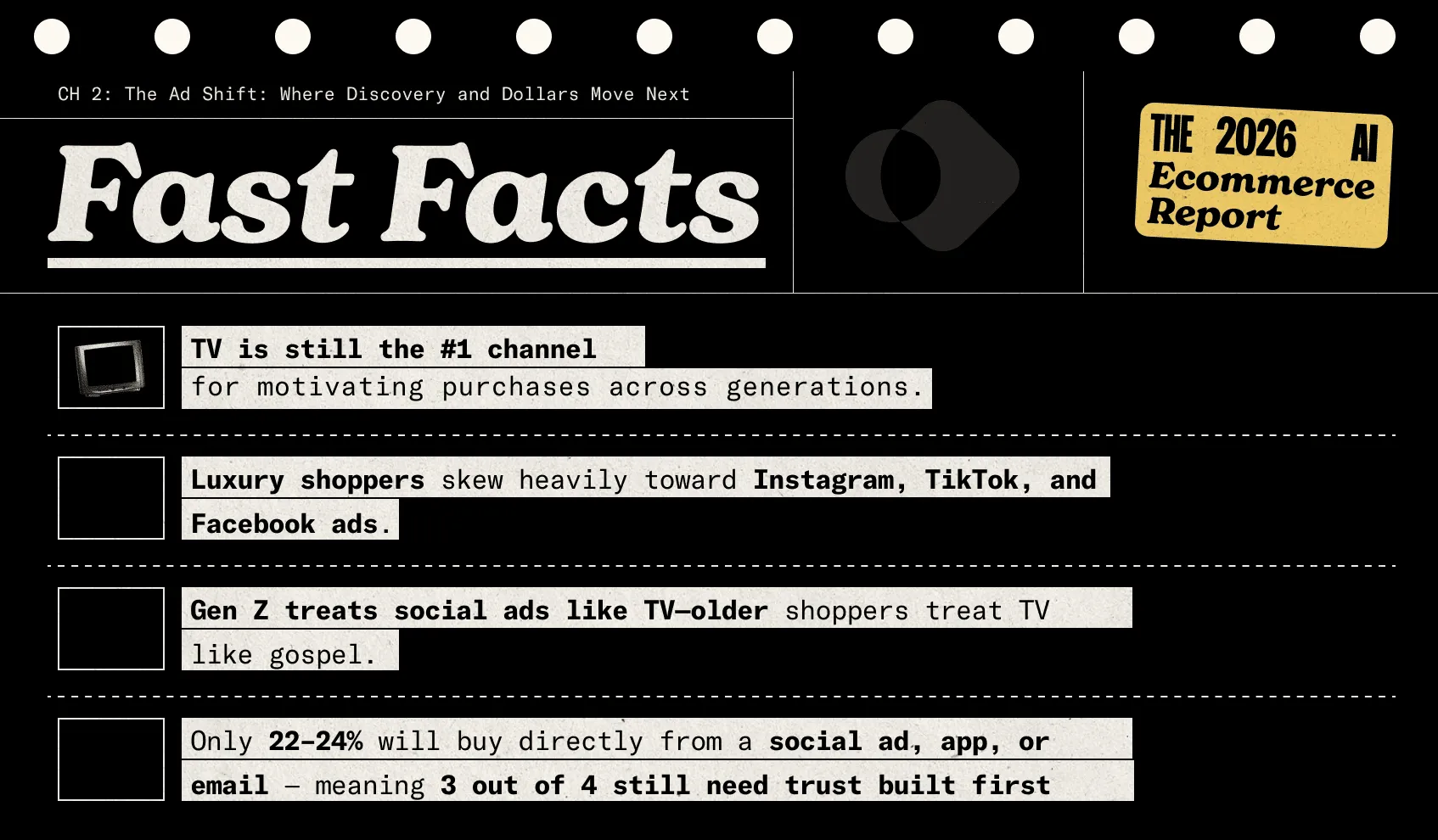
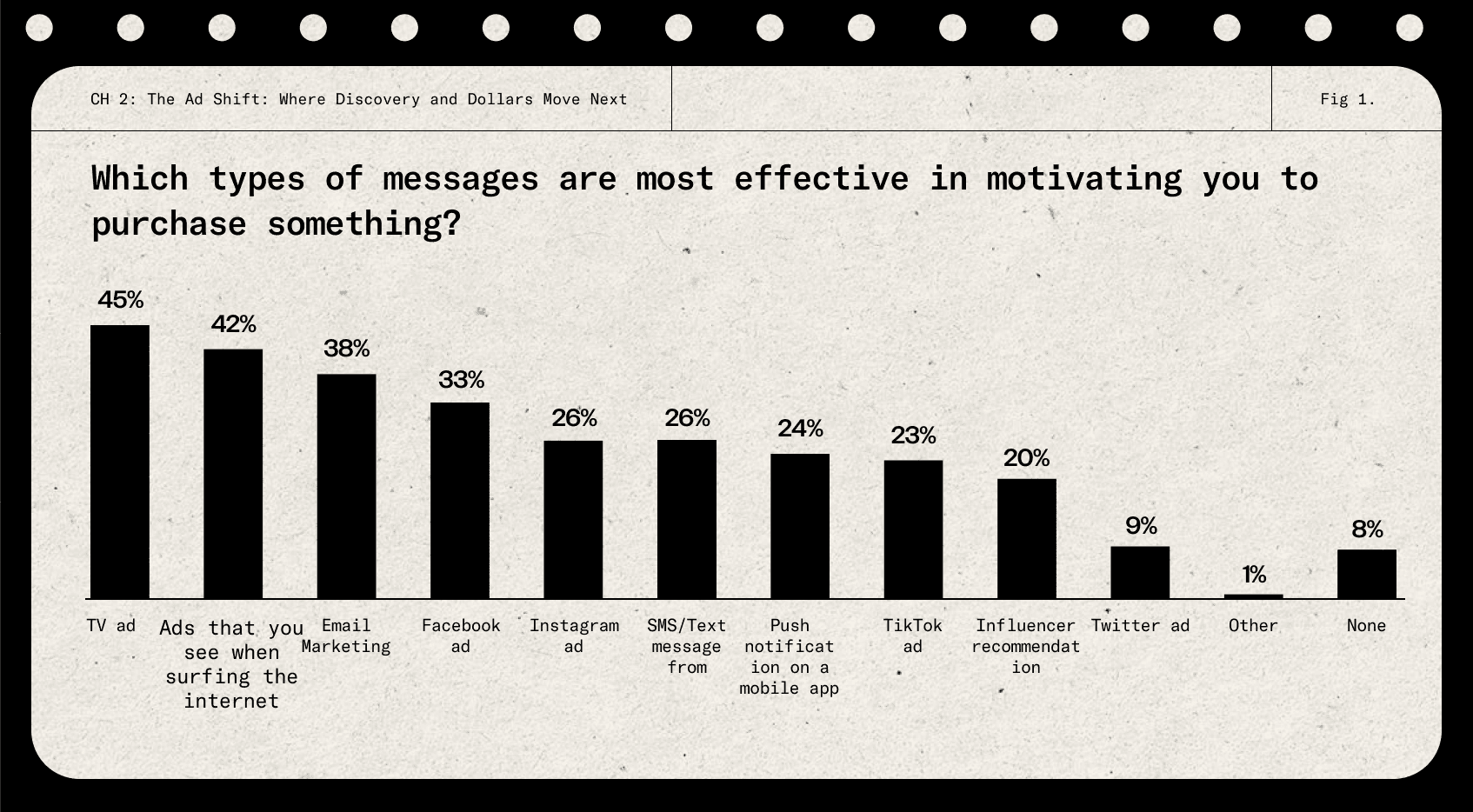
- TV still leads overall. It remains the most effective channel for motivating purchases, especially among shoppers over 45.
- Digital ads are nearly as strong. Internet ads perform just behind TV, and email + Facebook/Instagram are the only other channels that motivate at least one-third of shoppers.
- Social dominance among younger consumers. Instagram and TikTok ads rise sharply among younger respondents, often matching or surpassing traditional channels for early discovery.
2. Conversion Comfort: Where Shoppers Are Willing to Buy Immediately
- Direct-from-ad purchasing is now mainstream — for some.
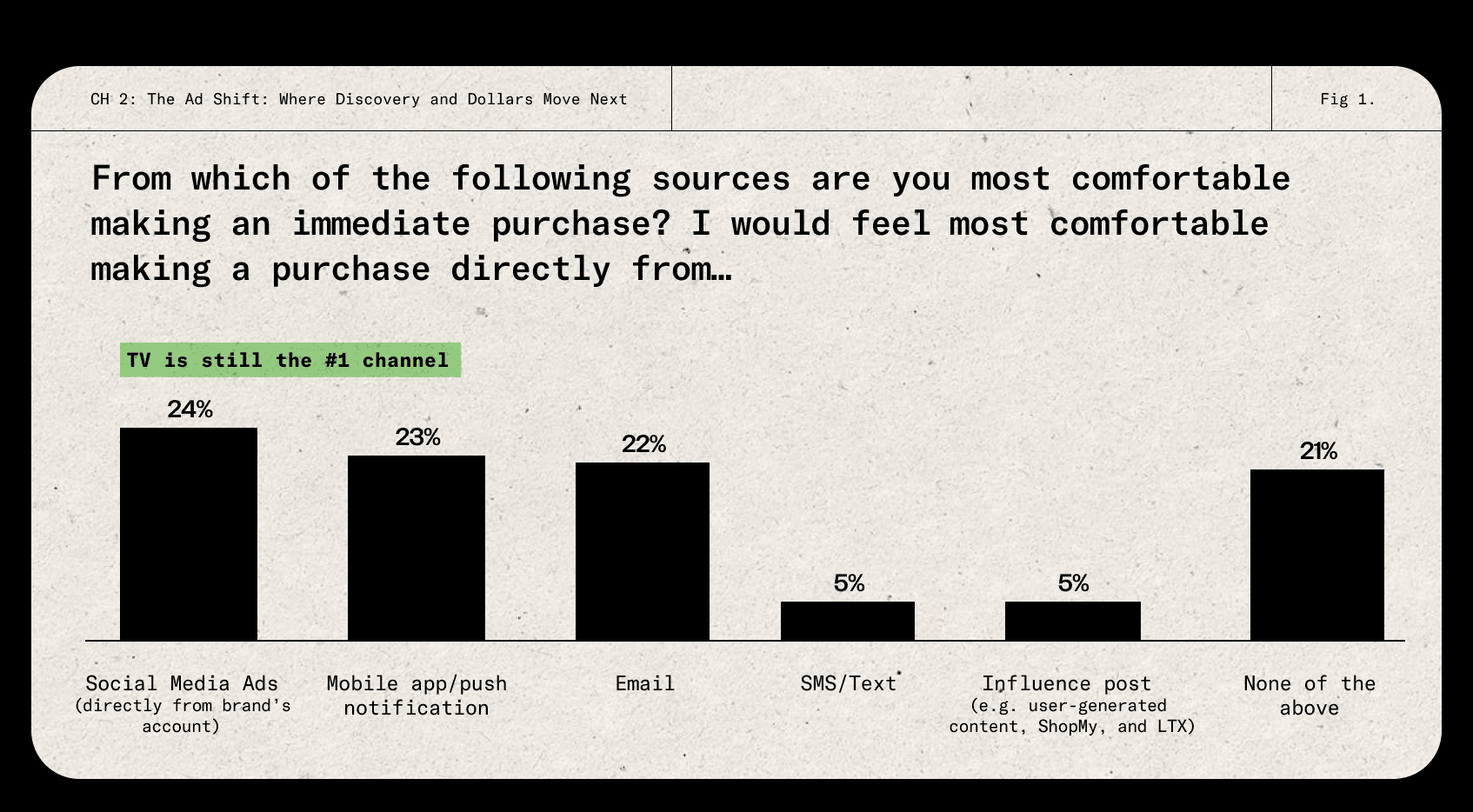
- Nearly 1 in 4 shoppers say they’re most comfortable buying directly from:
- a social ad (24%)
- a mobile app (23%)
- an email (22%)
- ~20–25% → none of the above (varies by cohort)
- But trust gaps remain. Only 5% feel comfortable purchasing through influencer content or SMS.
- And skepticism is rising. A similar share of respondents say they wouldn’t buy directly from any channel — a major trust signal that affects ad-to-checkout strategy.
3. Generational Segmentation: The Sharpest Divide in the Data
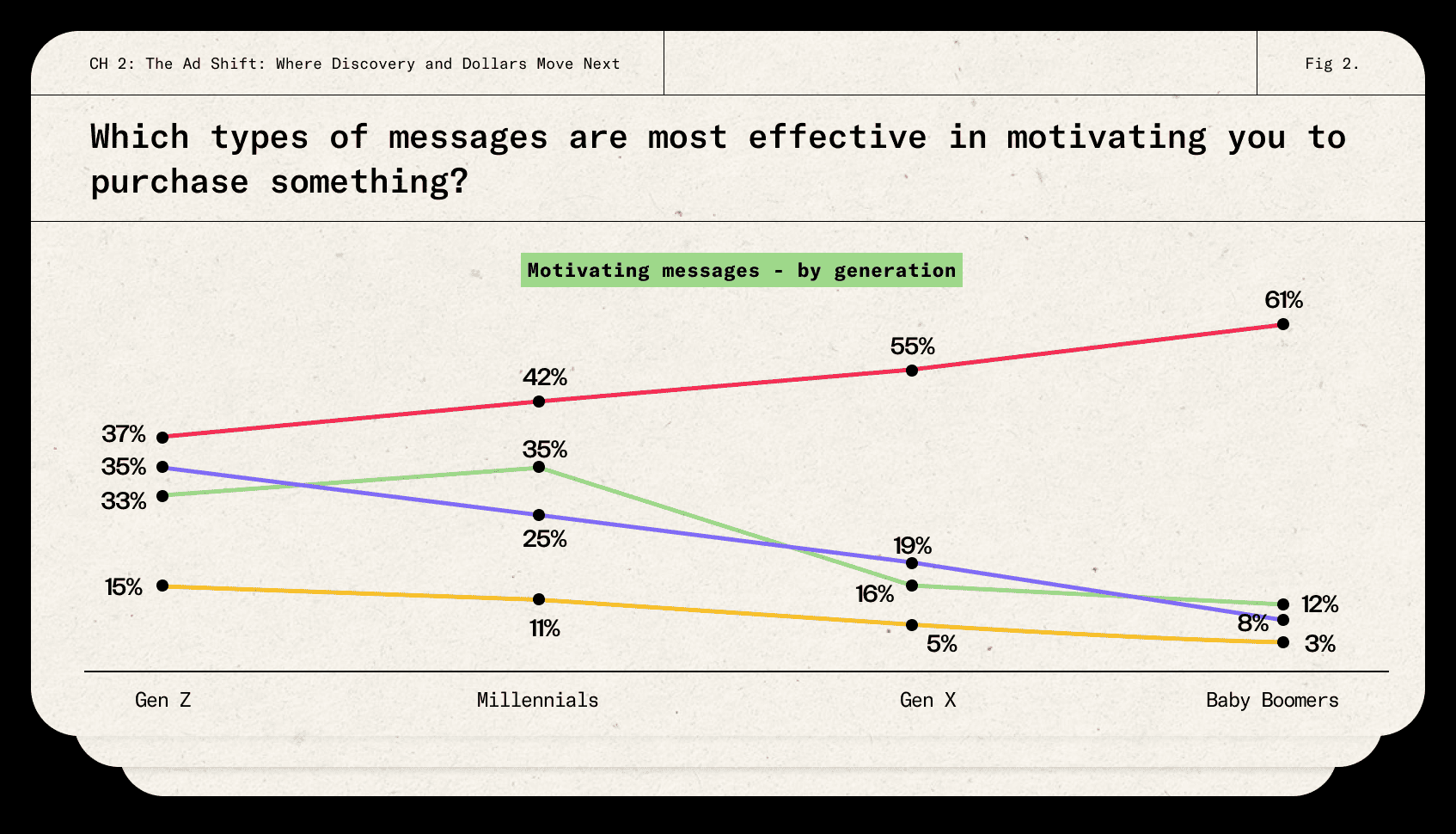
- Gen Z treats social like TV. Among Gen Z, Instagram and TikTok are as effective as TV at motivating purchases — a pattern not seen in any older cohort.
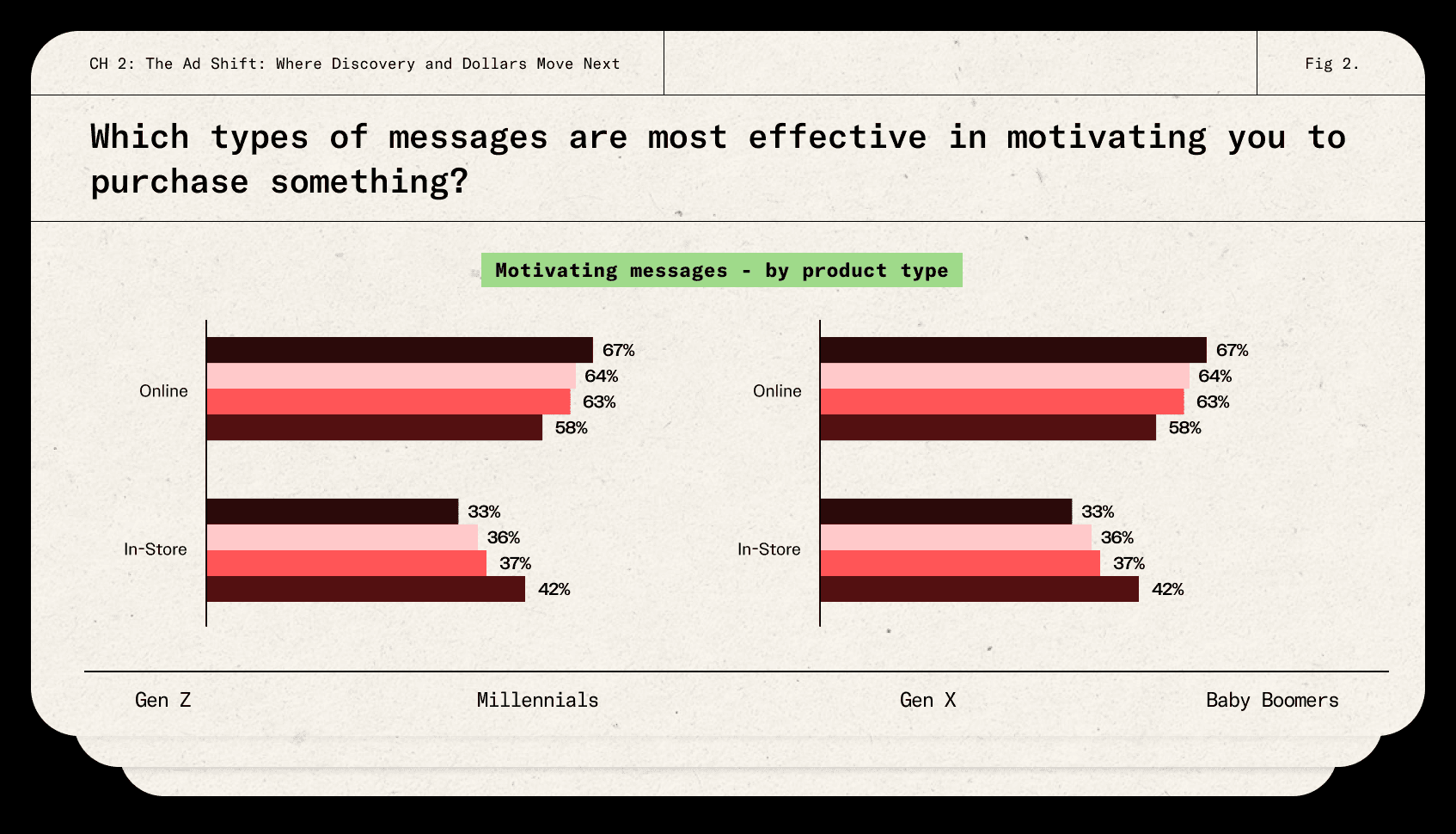
- Effectiveness declines with age. Social ad impact drops steadily after age 30, while TV and email rise significantly for Gen X and Boomers.
- Older shoppers require clarity and trust. Boomers convert best on channels that feel linear, informative, and familiar — TV and email remain their gold standard.
4. Luxury Buyers: The Most Distinctive Audience Segment
- Luxury and jewelry shoppers skew social, hard.
They are far more likely than average shoppers to be influenced by:- TikTok
- Visual-first environments matter. These shoppers respond strongly to premium imagery, vertical video, and aspirational creative.
- High-touch personalization influences conversion. Luxury buyers reward brands that match tone, exclusivity, and emotional resonance across every touchpoint.
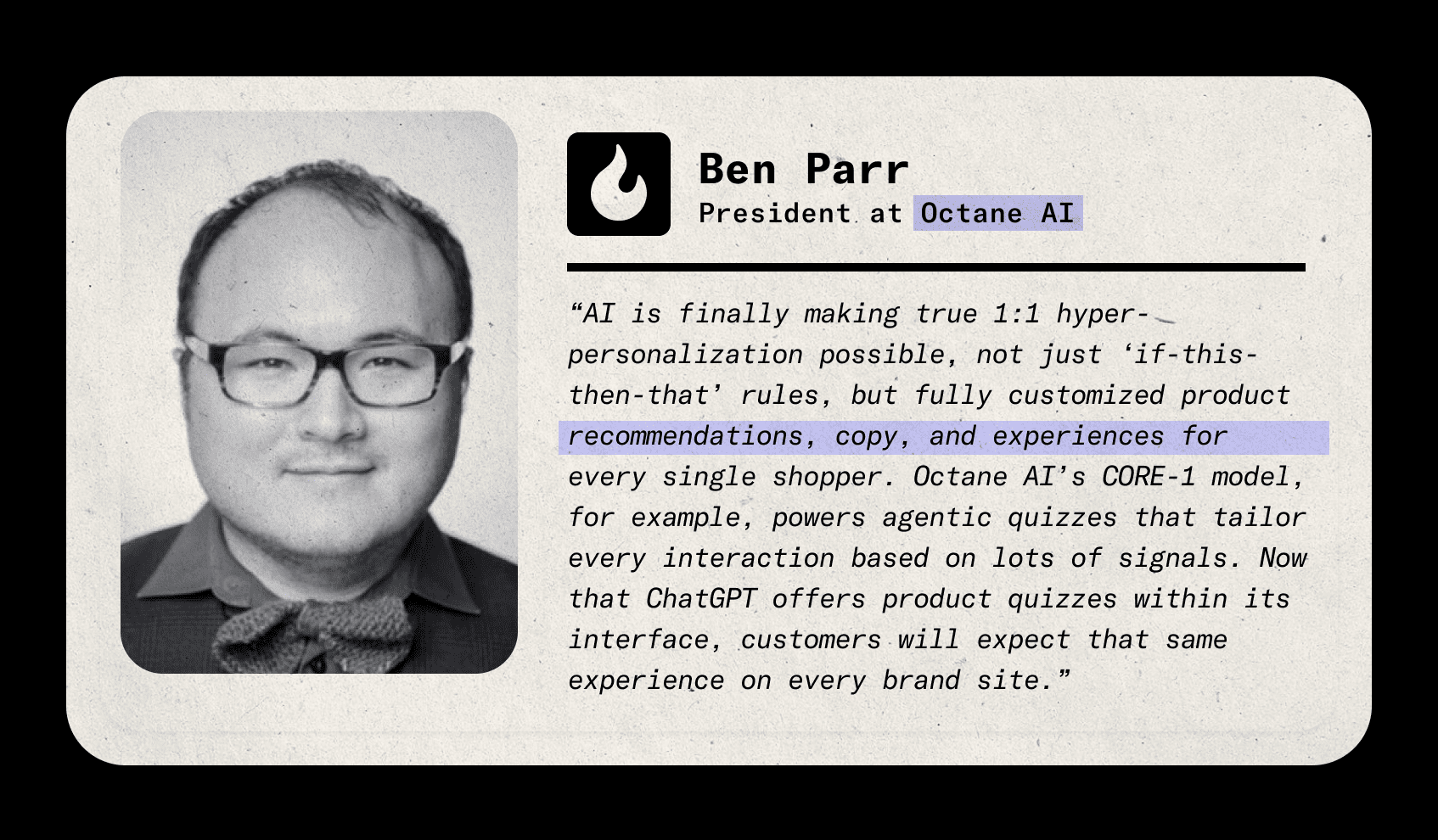
Expert POV: AI for 1:1 Personalization & Interactive Experiences
What It Means for Brands
Why Fragmented Attention Is Quietly Blowing Up Your CAC
The customer journey is fragmenting faster than most brands can keep up with. Shoppers now discover, evaluate, and convert across entirely different emotional environments, and the gap between those environments is widening.
- Rising CAC means misallocated spend is more expensive than ever.
- Creative mismatch (wrong tone, wrong channel, wrong moment) erodes trust instantly.
- Emotional resonance varies by audience, and the gap is widening: Gen Z needs social-first storytelling; Boomers want email and TV clarity.\
- Luxury and premium shoppers demand high-touch personalization, and tolerate fewer friction points.
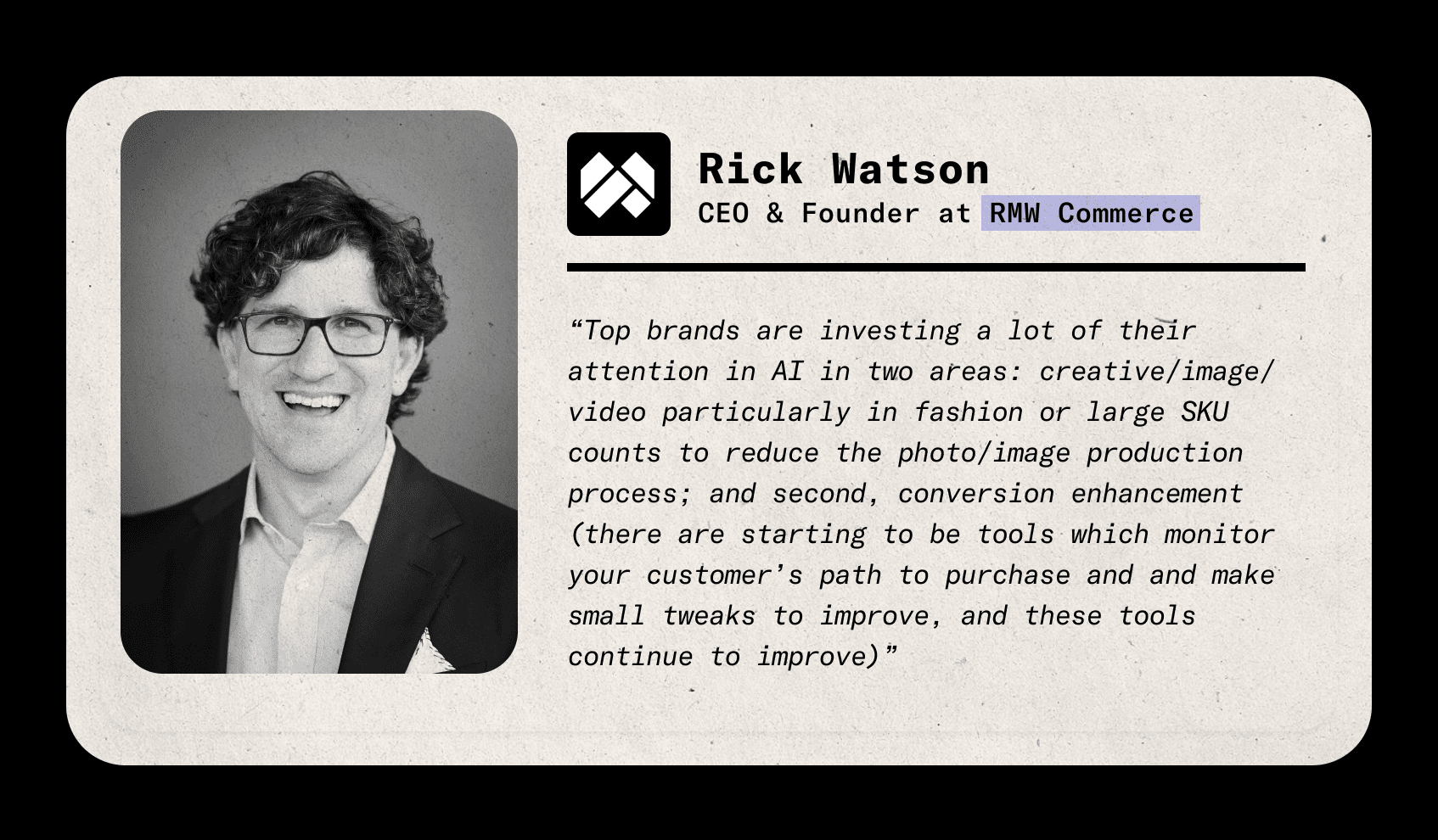
Expert POV: AI for Creative + Conversion Enhancement
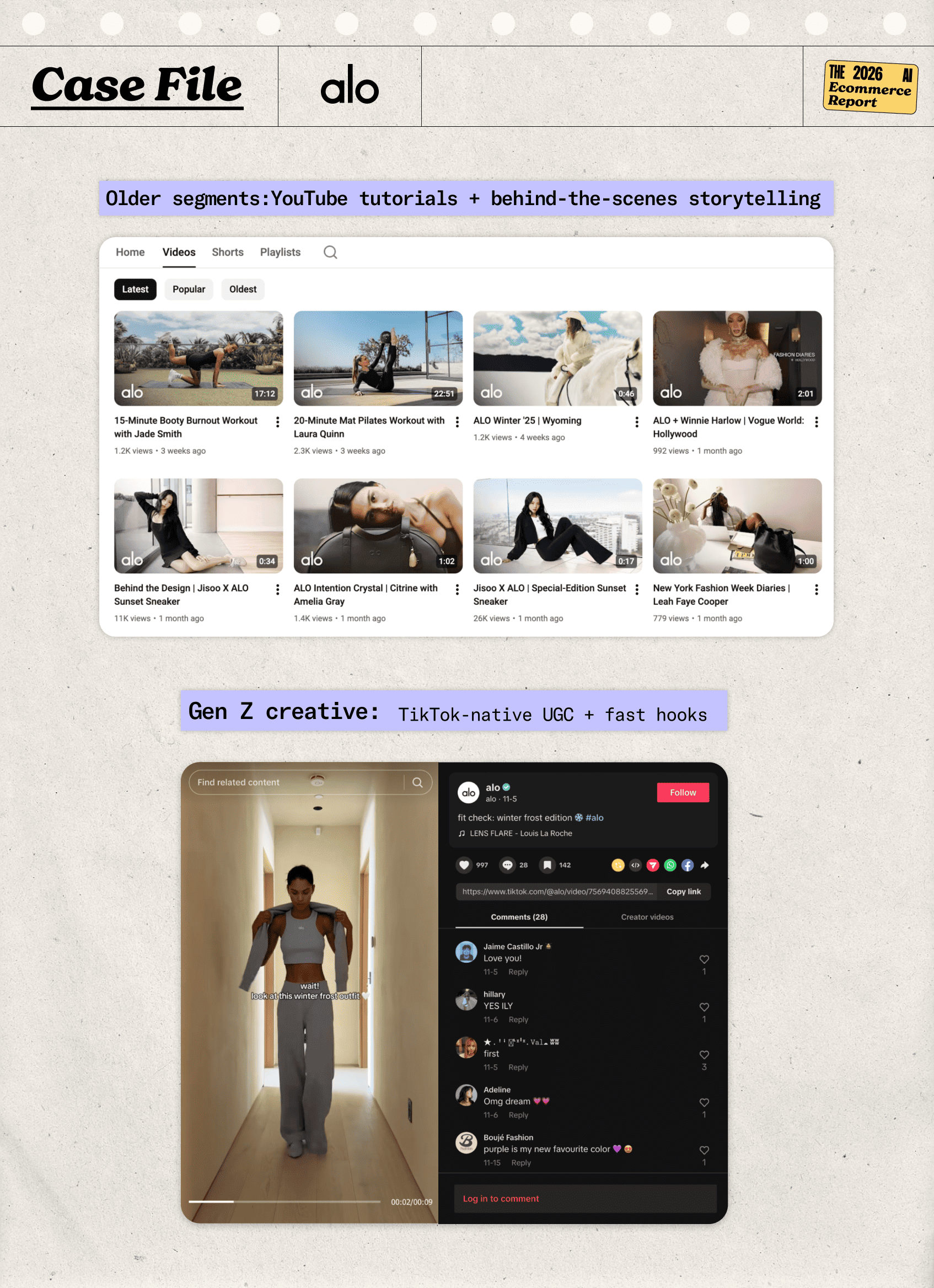
Case File - Alo: Narrative Continuity Across Every Channel
Alo reduces funnel drop-off by tailoring creative to the channel and audience (TikTok-native UGC for Gen Z; longer-form tutorials/BTS for older shoppers) while keeping the story consistent from ad → PDP so every click feels like a seamless continuation.
Steal this play:
- Pick one “hero SKU” per campaign and let it carry the story across social, landing, PDP, and retargeting.
- On PDP, lead with proof—not poetry: feature callouts, use-case images, and “this solves X” clarity above the fold.
- Keep the promise consistent: if the ad sells “the perfect travel bag,” the PDP should immediately show travel-specific proof (compartments, organization, carry-on fit).
Case File - Calpak: Validates TikTok Hype with Proof-Led PDP Design
CALPAK turns TikTok discovery into conversion by rallying campaigns around a single hero product (the Luka Duffel) and using the PDP to instantly validate the hype with scannable utility proof (features, use cases, “why it’s worth it”) that makes checkout feel obvious.
Steal this play:
- Pick one “hero SKU” per campaign and let it carry the story across social, landing, PDP, and retargeting.
- On PDP, lead with proof—not poetry: feature callouts, use-case images, and “this solves X” clarity above the fold.
- Keep the promise consistent: if the ad sells “the perfect travel bag,” the PDP should immediately show travel-specific proof (compartments, organization, carry-on fit).
AI Actions to Try Now
How AI Cuts CAC and Lifts ROAS Across Channels
1. Predictive Channel Allocation: Stop Funding the Wrong Screens (Thinking AI)
Your audiences aren’t just scattered across different channels, they emotionally prefer different ad environments.
- Older shoppers respond strongest to TV and email, where messaging feels linear, informative, and familiar.
- Gen Z and luxury buyers convert on TikTok, Instagram, and vertical video, where storytelling feels fast, aspirational, and visual-first.
The challenge with this? Human teams are too slow to manually redistribute budget across fragmented channels, especially when performance shifts hourly during peak season.
Try This AI Tactic:
Use predictive models to automatically identify the highest-converting channel by:
- Age (Gen Z vs Boomers)
- Category (luxury vs essentials)
- Intent level (browsers vs cart abandoners)
- Past engagement (click depth, session quality, add-to-carts)
Expert POV: Why Channel & Creative Misalignment Drives Costs Up
2. Emotionally Aligned Creative: Matching the Mood, Not Just the Demographic (Feeling AI)
Different audiences don’t just prefer different channels, they prefer different emotional languages.
AI can autonomously tailor tone, structure, and visual identity to match:
- Vertical, high-energy video for younger shoppers
- High-trust, clarity-first messaging for older audiences
- Aspirational, premium visuals for luxury buyers
- Problem/solution frameworks for essentials shoppers
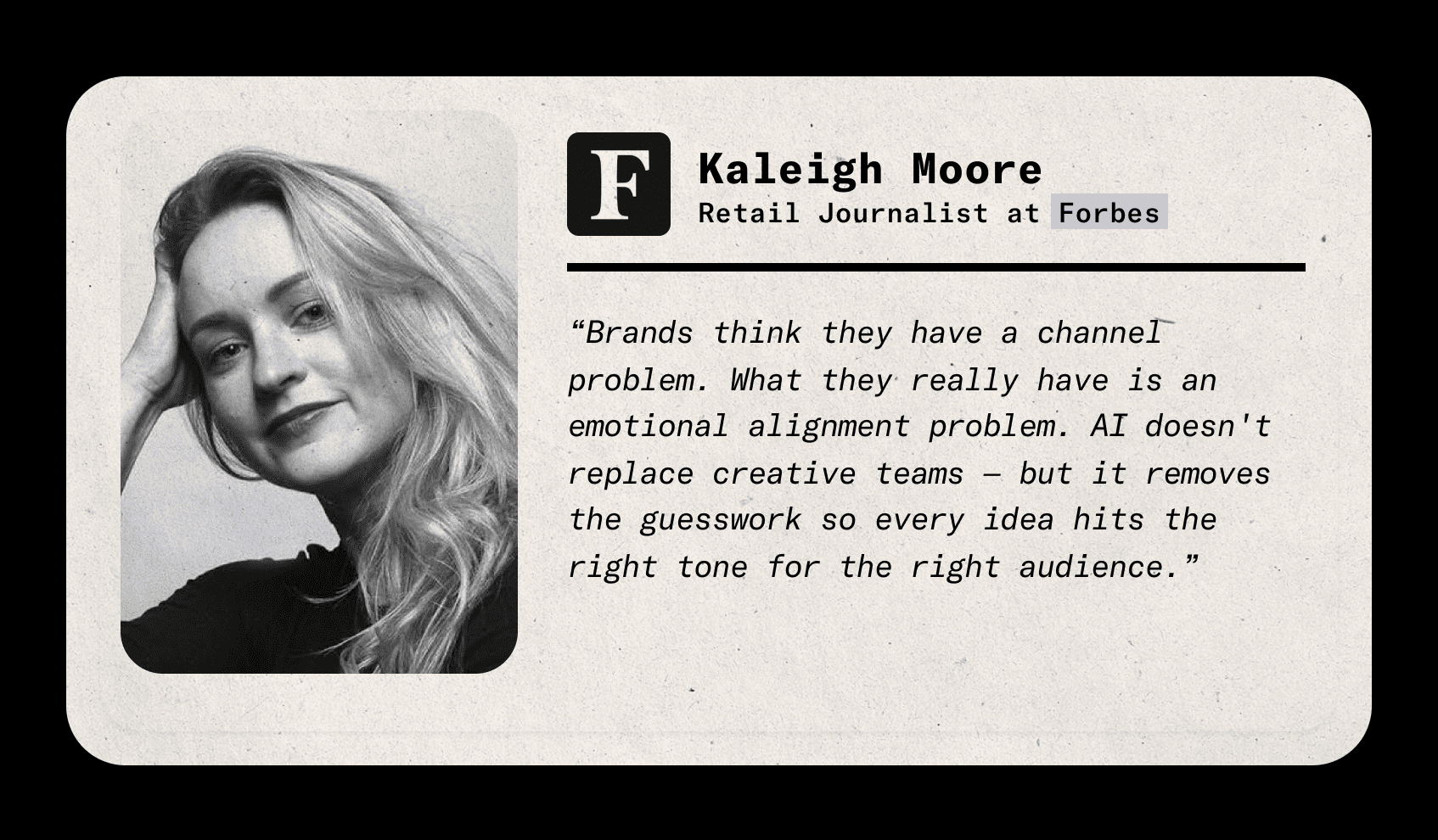
This matters because the real conversion killer isn’t bad creative, it’s emotionally mismatched creative. What AI now does automatically is
- Adjusts ad tone to match demographic sentiment
- Autogenerates dozens of creative variants for testing
- Predicts which visuals will outperform before launch
- Localizes the “energy” of each ad to the culture of the platform (TikTok ≠ Reels ≠ TV ≠ email)
AI is making ads faster and emotionally accurate.
3. Narrative AI: Making Every Click Feel Like the Same Story (Narrative AI)
Today’s shopper doesn’t move through a linear funnel. They’re bouncing all over the place, across multiple channels and touchpoints.
A TikTok ad → an IG Story → your mobile app → an email → the checkout.
This is where most brands lose conversions: the tone, visuals, and messaging don’t match.
If the first touchpoint feels fun and modern, but the PDP feels generic or outdated, the buyer feels a story break and drops.
Since ~1 in 4 consumers is now comfortable buying directly from an ad, AI must ensure the entire journey feels like one continuous experience:
The ad →The landing page → The PDP → The app → The email → The push…
…all share the same emotional arc.
What AI does here:
- Carries over messaging from ad → PDP automatically
- Surfaces ad-referenced attributes in the product page modules
- Syncs visuals across paid + owned channels
- Adjusts tone dynamically based on the ad that brought the user in
- Creates persistent narrative “threads” across touchpoints
This unlocks a connected, story-driven buying experience that feels intentional, not stitched together.
Mini AI Toolbox
AI Assistants
- Notion AI Agents Collection (Paid) — Prebuilt multi-agent automations for campaign planning, creative, and analytics.
- ChatGPT Prompts Library for Marketers (Free) — Structured frameworks tailored to ecommerce, segmentation, and storytelling
AI Creative Tools
- AdCreative.ai — Generates image + video ads using your URL, scores them on predicted performance, and integrates with Meta/Google for rapid testing.
- Pencil — Builds ad variants and assigns each one a predictive “Pencil Score” to prioritize winning concepts.
- Creatify — Lightweight tools for spinning up fast video/image variants for lean teams.


