


When we started Tapcart, having a mobile app was something only the biggest brands could realistically pull off. Custom apps were expensive, slow to ship, and even slower to update. Most Shopify brands either couldn’t justify the cost, or they couldn’t keep an app fresh once it launched.
Our goal back then was straightforward: make it easy for any brand to launch a beautiful, high-performing mobile app without needing a full dev team.
Today, the question isn’t “Can you launch an app?” It’s this:
Can your app keep up with your customers automatically—without drowning your team in busywork?
That’s the future we’re building toward with Tapcart AI.
Shoppers Live in Adaptive Feeds. Your Storefront Should Too.
Your customers spend hours inside experiences that learn what they want in real time: TikTok, Instagram, YouTube, Netflix, Spotify. Every interaction teaches the product what to show next. The experience adapts instantly. It feels fresh and like it was built just for them.
Then those same customers open most ecommerce experiences and see the same homepage as everyone else. The same cart reminder they’ve seen for years. The same promos, same layout—no matter who they are or how many times they’ve bought from you.
It’s not that brands don’t want to be more personal and relevant. It’s that the cost has been too high:
- Rebuilding campaigns for every channel
- Writing endless variations of email, SMS, and push
- Managing segments, flows, and rules across multiple tools
- Trying to keep the app in sync with the site manually
That’s why an app often becomes an afterthought. Not because leaders don’t believe in mobile, but because they can’t justify another channel that “requires another team” (side note: it doesn’t, this is a common misconception).
Brands want to do more here. They just need more leverage to do it. Shoppers have moved on. It’s time the tools catch up.
Brands Don’t Need More Tools. They Need Less Busywork.
When I talk with ecommerce and marketing leaders, I rarely hear that they lack ideas. I hear that they lack time.
Launching a campaign today usually means building it on the site—then rebuilding it for email, SMS, paid, and (if you have an app) rebuilding it again for mobile. You spend time replicating the same work across different platforms just to stay consistent.
Every new idea means more tickets, more wires, more segmentation rules.
Our view at Tapcart is simple: brands don’t need more knobs and dashboards. They need less busy work and more leverage.
That’s why we’ve spent the last few years rebuilding Tapcart around one idea:
Your storefront should feel fresh for your customers and for your team.
What We Mean by “AI-Native” Mobile Commerce
There’s a big difference between being AI-enabled and AI-native.
Most “AI features” in ecommerce today bolt intelligence onto yesterday’s workflows. You still build the same campaigns, wire up the same flows, and then flip an “AI” switch to tweak copy or recommend a product.
We wanted to do something different.
For us, AI-native means the intelligence layer sits at the core of the experience and not on top of it. In plain terms: your app doesn’t just display products. It learns what shoppers respond to and helps run the channel with less manual effort.
It means your app:
- Learns continuously from real behavior
- Updates itself as your site and catalog change
- Generates experiences and messages at a scale no human team can match
Tapcart AI is built with Google Gemini models on the underlying AI infrastructure so that the hard part (the modeling, the learning, the optimization) can be handled behind the scenes with Google’s most capable AI models to-date, while the result stays incredibly simple for teams to run.
Tapcart AI: One Connected System
From a merchant’s perspective, Tapcart AI is one connected system that does three jobs:
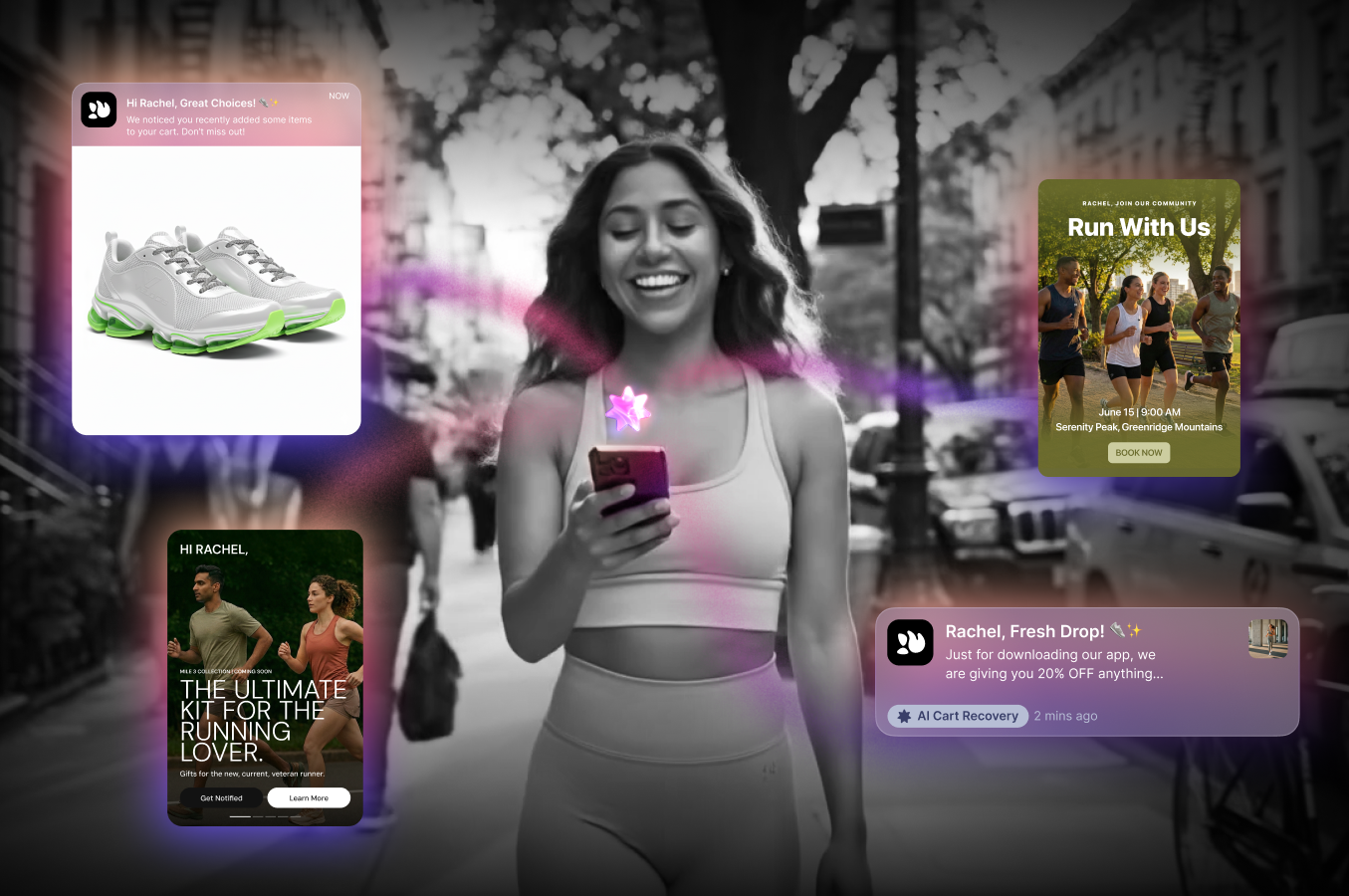
- AI-powered messaging (push + lifecycle): push that feels like it was written for a person across the customer journey, not a segment (like cart recovery)
- AI-assisted app management: your app stays in sync with your site without duplicating work based on what shoppers do
- 1:1 shopper experiences: every shopper sees a more relevant app with featured products, content, and prioritized offers—all based on their intent and real-time behavior
All designed around one philosophy: consumers first, operator efficiency as a byproduct.
Early Results from Leading Brands
We’ve been rolling pieces of this system out with select merchants through a beta, and early results have been exciting.
On Tapcart’s v20 foundation, migrated apps are already seeing some of the highest conversion rates we’ve ever recorded. Two leading fashion/apparel brands have seen conversion rates in the 8.5–10% range—numbers that are difficult to reach with a traditional, manually maintained stack.
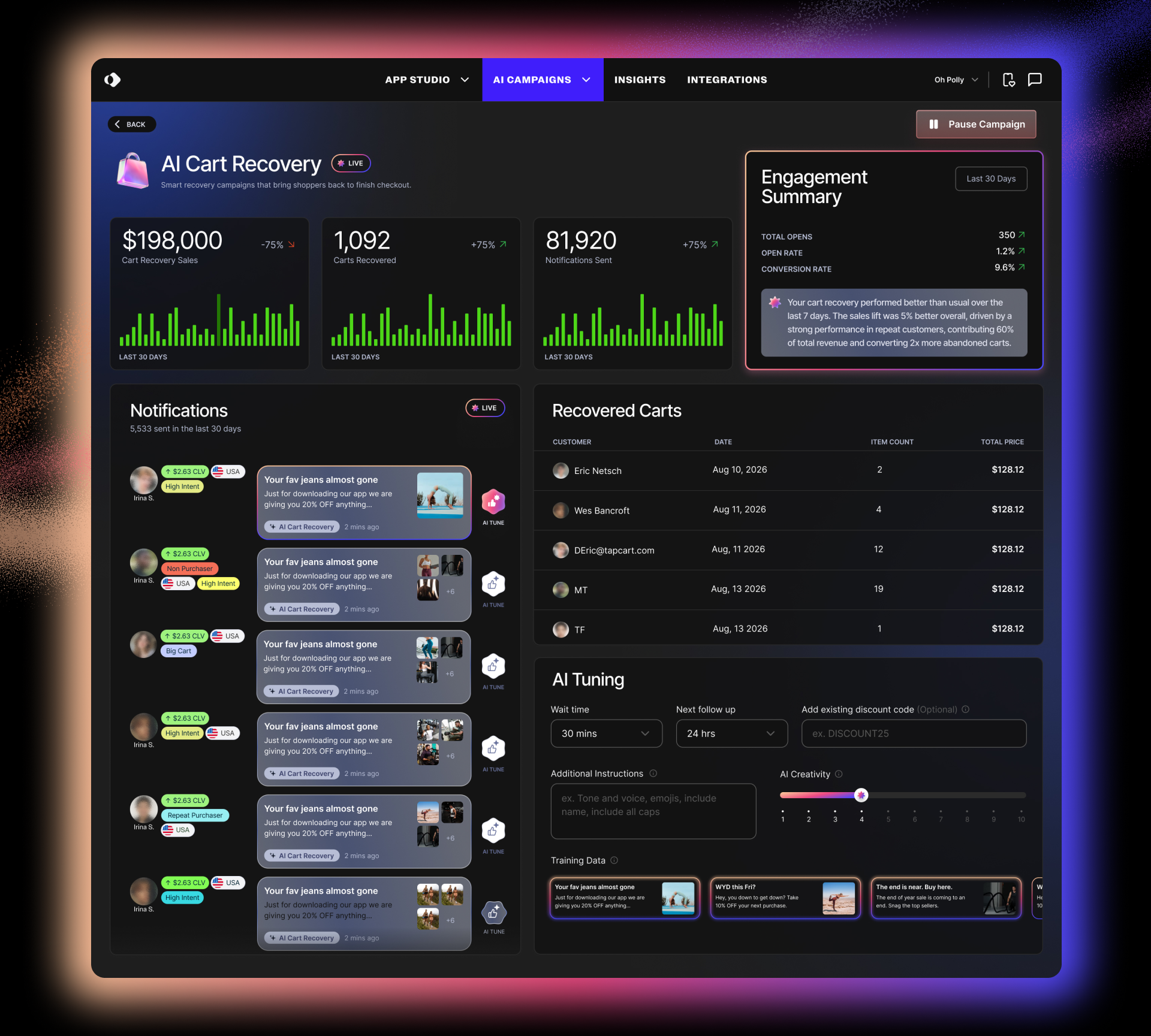
For one of these leading fashion brands, we tested AI Cart Recovery against their existing cart recovery approach. In a single week, AI Cart Recovery:
- Recovered well over 140 carts
- Drove more than $20K in additional revenue
- Delivered a conversion rate north of 18% on those recovered carts
- Sent almost 90,000 AI-generated notifications without the team having to manually configure rules or messages
Directionally, the AI-driven approach materially outperformed their legacy setup.
These aren’t small experiments. They’re signals from some of the most sophisticated operators in ecommerce that AI-native mobile isn’t just a nice story—it drives performance.
What This Means for the Next Era of Ecommerce
There’s a lot of speculation right now about what AI will do for jobs in ecommerce and marketing. Our view is straightforward: the goal isn’t to replace teams. It’s to remove the parts of the job no one signed up for.
The endless cloning of campaigns. Manual segments. Routine copy updates. Rebuilding the same launch across five channels.
Instead of writing your fifth version of “Don’t forget your cart,” you’re thinking about strategic business growth, creative concepts and offers. Instead of rebuilding a campaign four times, you’re partnering with merchandising and product on what should be promoted next.
When we say “apps should run themselves,” that’s what we mean. The app should be smart enough to stay current and adapt to behavior, so your team can focus on the uniquely human decisions: what good looks like for your brand and your customer.
This Is Only the Beginning
I don’t think the future of commerce will be defined by a bunch of disconnected smart features. I think it will be defined by storefronts that feel alive:
- They respond to behavior
- They adapt to every shopper
- They get better every time someone engages
Everything we’re launching today lays the groundwork for a new era of mobile commerce. One where apps aren’t just updated, but adaptive; where teams aren’t bogged down by busywork, but elevated by smarter tools; and where every shopper feels like your brand was designed for them.
If you’re rethinking your mobile strategy for 2026, my view is simple:
You don’t need more channels.
You don’t need more manual workflows.
You need a storefront that can finally keep up.
If you’re exploring what an AI-native mobile app could unlock for your brand, we’d love to show you what Tapcart AI makes possible. Get a walkthrough today.
About the author







.avif)


