



Mobile is no longer just a channel. It’s the storefront.
In 2025, mobile commerce generated approximately $2.5 trillion globally, accounting for nearly 60% of all retail ecommerce sales, and it’s projected to exceed $2.7 trillion in 2026, continuing to outpace overall ecommerce growth.
In other words: the majority of online revenue is now happening on phones, not desktops.
This shift isn’t theoretical:
- Mobile commerce grew over 21% year-over-year in 2025, significantly faster than ecommerce as a whole.
- In the U.S. alone, mobile now drives over 44% of total ecommerce sales.
- Globally, shoppers are increasingly app-first — with over 80% of consumers using mobile apps to browse or purchase, and more than half of all online purchases now happening on mobile devices.
For ecommerce brands, this changes the math.
As acquisition costs rise and paid channels fragment, retention, repeat purchase, and owned channels are where growth is won. And no channel compounds those advantages like a native mobile app when it’s built on the right foundation.
The brands winning on mobile aren’t just optimizing responsive websites. They’re investing in native mobile experiences designed for speed, retention, and repeat purchasing.
Native apps consistently outperform mobile web: driving up to 3× higher conversion rates and stronger repeat behavior over time. Consumers feel the difference: 76% say they prefer shopping in a brand’s app, citing speed, saved login information, and personalized experiences as the biggest reasons.
As acquisition costs rise and paid channels fragment, retention, personalization, and owned channels are no longer optional. They’re the foundation of sustainable growth, and mobile apps are increasingly where that value compounds.
Yet despite mobile’s dominance, many Shopify brands still struggle with the same question:
Which mobile app platform will actually support our growth, and not just help us launch?
On the surface, most platforms look similar. Many claim to be “native,” “flexible,” or “built for scale.” Some are lightweight wrappers around a website. Others rely heavily on managed services, custom builds, or developer-heavy workflows. And while these approaches can work early on, they often introduce friction as:
- teams grow,
- launch cadence increases,
- personalization becomes critical,
- and reliability during peak moments starts to matter.
That’s why the real question in 2026 isn’t whether your brand should have a mobile app.
It’s what kind of mobile app platform you’re choosing, and what that choice will cost you over time.
Why Choosing a Mobile App Platform Is an Operating Model Decision
This guide is built for the people responsible for that decision:
- Ecommerce operators and growth leads who need to move fast, launch often, and optimize without developer bottlenecks.
- Technical stakeholders who care about architecture, integrations, data access, performance, and long-term maintainability.
- Executive leaders who need confidence that today’s platform choice won’t turn into a replatforming project 12–18 months from now.
In this guide, we’ll break down:
- What actually qualifies as a best-in-class ecommerce app in 2026
- The most common traps brands fall into when evaluating mobile app platforms
- Why certain approaches like wrapped websites, PWAs, and services-heavy platforms tend to break down at scale
- How leading Shopify brands evaluate performance, flexibility, scalability, and real-world outcomes when choosing a platform
Whether you’re launching your first app or reassessing an existing one, this framework is designed to help you choose a mobile platform that doesn’t just launch fast, but continues to perform, compound, and scale as your business evolves.
How to Evaluate Mobile App Platforms for Long-Term Scale
As mobile becomes the primary storefront for ecommerce, choosing the right app platform is no longer a tactical decision... it’s an operating model decision.
In 2026, the best mobile app platforms aren’t defined by how quickly they can launch an app.
They’re defined by how efficiently teams can execute, iterate, and grow after launch as complexity increases, teams change, and customer expectations rise.
High-performing Shopify brands don’t evaluate mobile platforms on surface-level features alone. They look for platforms that compound advantages over time in speed, retention, and internal leverage.
When evaluating mobile app platforms today, leading brands consistently prioritize the following criteria:
1. Performance that holds up under real-world conditions
Speed still matters, but not just initial load time.
Look for platforms that deliver consistent, native performance across the entire customer journey: discovery, browsing, PDPs, checkout, and post-purchase engagement. Performance should remain stable even as you layer in personalization, integrations, campaigns, and traffic spikes.
In 2026, performance is table stakes. Reliability at scale is the differentiator.
2. Operator speed and execution ownership
Your app should be easy for operators to manage day to day.
If every merch update, layout change, or campaign requires developer support or a support
If every homepage update, merchandising change, or campaign requires a developer, an agency, or a support ticket, optimization slows, and mobile stops being a growth channel.
The strongest platforms enable marketers and ecommerce teams to ship, test, and iterate in real time, without sacrificing governance, UX consistency, or performance.
The best platforms today act as a collaborator, using AI to eliminate busy work entirely. Look for features like AI Autopilot that continuously monitor your site and automatically generate suggested app blocks and pushes so you can publish updates in seconds with zero double work.
3. Flexibility without turning the app into a dev project
Modern ecommerce teams need to experiment constantly: launches, exclusive drops, loyalty mechanics, community features, personalization, and new formats.
True flexibility doesn’t mean “anything is possible with enough custom work.”
It means teams can build advanced experiences quickly without introducing fragility, overhead, or long-term maintenance risk.
In 2026, flexibility that requires constant custom development is no longer a competitive advantage… it’s a liability.
True flexibility also means removing creative bottlenecks; modern, AI-native platforms allow you to instantly place products into curated environments and add gen-AI photos and videos right into your app without the delays of a photoshoot.
4. Deep, native integration with your existing stack
Your mobile app shouldn’t operate as a silo.
Look for platforms that integrate natively and in real time with the tools you already rely on: Shopify, analytics, attribution, loyalty, reviews, subscriptions, CRM, and messaging. Clean data flows and reliable event tracking are essential for both operators and technical stakeholders.
The best platforms reduce integration complexity instead of pushing it onto your team.
5. Retention and personalization as core capabilities
As acquisition costs rise, retention becomes the primary growth lever.
Mobile platforms should treat push notifications, lifecycle messaging, segmentation, and personalized content as first-class capabilities — not optional add-ons or bolt-on tools.
In 2026, the question isn’t whether a platform supports retention — it’s how much of the work is automated vs. manually configured, and how quickly teams can act on customer behavior.
Shoppers today expect an app that engages like Instagram and converts like Amazon. A self-optimizing storefront achieves this by continuously learning from shopper behavior to create a 1:1 experience. This includes AI Push Notifications that trigger based on individual behaviors , AI Offers that personalize incentives to protect your margins that automatically adapts to each shopper's interests in real time.
6. Scalability, maintainability, and team resilience over time
The true test of a platform isn’t launch day. It’s month 12, month 24, and beyond. Consider how the platform handles team changes, roadmap shifts, and increased complexity. Can new team members onboard quickly? Is visibility clear? Can the platform grow with your brand without forcing a replatform?
Consider how the platform handles:
- team growth and turnover
- increasing launch cadence
- expanding integrations and personalization logic
- peak traffic moments like BFCM
Can new team members onboard quickly?
Is visibility into what’s live and what’s changing clear?
Can the platform grow with your brand without forcing a replatform or a services dependency?
These criteria form the foundation of a strong mobile strategy. But not all “mobile apps” are built to meet them.
What Qualifies as a True Ecommerce App in 2026?
Not all mobile apps are created equal, and many solutions that look similar on the surface are built on very different foundations.
In 2026, a “true” ecommerce app isn’t defined by whether it technically runs on iOS and Android.
It’s defined by how well the platform supports speed, ownership, and scale once the app is live.
A true ecommerce app is a fully native iOS and Android application, built intentionally for commerce and designed to support the entire customer lifecycle, from discovery and conversion to retention and repeat purchasing, without introducing operational bottlenecks as teams grow.
The baseline for a best-in-class ecommerce app
At a minimum, a true ecommerce app should provide:
- Real-time Shopify data sync
Products, inventory, pricing, collections, and customer data stay accurate without manual intervention or brittle workarounds. - Embedded, native checkout
Customers complete purchases inside the app — not via link-outs to mobile web experiences that introduce friction and drop-off. - Push notifications as a first-class channel
Direct, owned communication with customers — not dependent on third-party channels or manual workflows. With AI Push, this means automatically sending thousands of highly personalized, rich notifications that trigger based on individual shopper behaviors. - Built-in personalization hooks
Dynamic content blocks, product feeds, segmentation, and lifecycle logic that support tailored experiences at scale. For example, AI Offers continuously learn and adapt to each shopper in real time, delivering a 1:1 experience without endless manual segmentation. - App Store compliance and governance
Stable releases, trusted updates, and long-term viability without risking performance or approval delays.
These capabilities enable what modern mobile experiences demand: immediacy, relevance, and seamless execution across the customer journey.
But in 2026, meeting the baseline is not enough.
Where many “mobile apps” fall short
Wrapped websites, WebViews, PWAs, and some hybrid or services-led approaches often position themselves as “mobile apps.” On paper, they may check several baseline boxes — but their limitations surface as brands scale.
Common issues include:
- Performance degradation under real-world conditions
Especially when personalization, campaigns, and integrations are layered in. - Limited access to native device capabilities
Constraining experimentation and advanced mobile behaviors. - Shallow retention and behavioral intelligence
Requiring manual setup, third-party tools, or custom logic to drive lifecycle growth. - Hidden dependency on developers, agencies, or vendors
Slowing iteration and shifting control away from operators. In contrast, an AI-native platform eliminates manual upkeep by automatically syncing web content and generating ready-to-publish app blocks directly for your team. - Reduced visibility and maintainability over time
Making it harder for new team members to understand what’s live, what’s changing, and how updates impact the app.
These approaches may work for early experimentation or simple use cases — but they often struggle to support retention-driven growth, fast iteration, and operational resilience as complexity increases.
For brands focused on long-term performance, the architecture behind an app matters just as much as the features on the surface.
The more natively — and intentionally — a platform is built for ecommerce, the better it can support experimentation, personalization, and scale without creating hidden drag or future replatforming risk.
How Top Shopify Brands Compare Mobile App Platforms
Once you’ve cleared the baseline of what counts as a true ecommerce app, the next step is comparing platforms using criteria that actually predict long-term success.
Because here’s the reality: most platforms can help you launch. The real differences show up when you need to:
- optimize weekly (or daily),
- run high-stakes launches,
- personalize experiences at scale,
- integrate with your full stack,
- and keep performance and retention high as complexity grows.
To make this decision easier, use the framework below. It’s the same set of categories we see high-performing teams evaluate when choosing (or replacing) an app platform.
The 2026 Mobile App Platform Evaluation Matrix
Not all mobile app platforms are built the same.
Some are product-led platforms designed for operator ownership. Others rely more heavily on managed services, developer resources, or web-based architectures.
The comparison below includes each platform’s core operating model to help you evaluate not just what’s possible, but how much work your team takes on to make it happen.
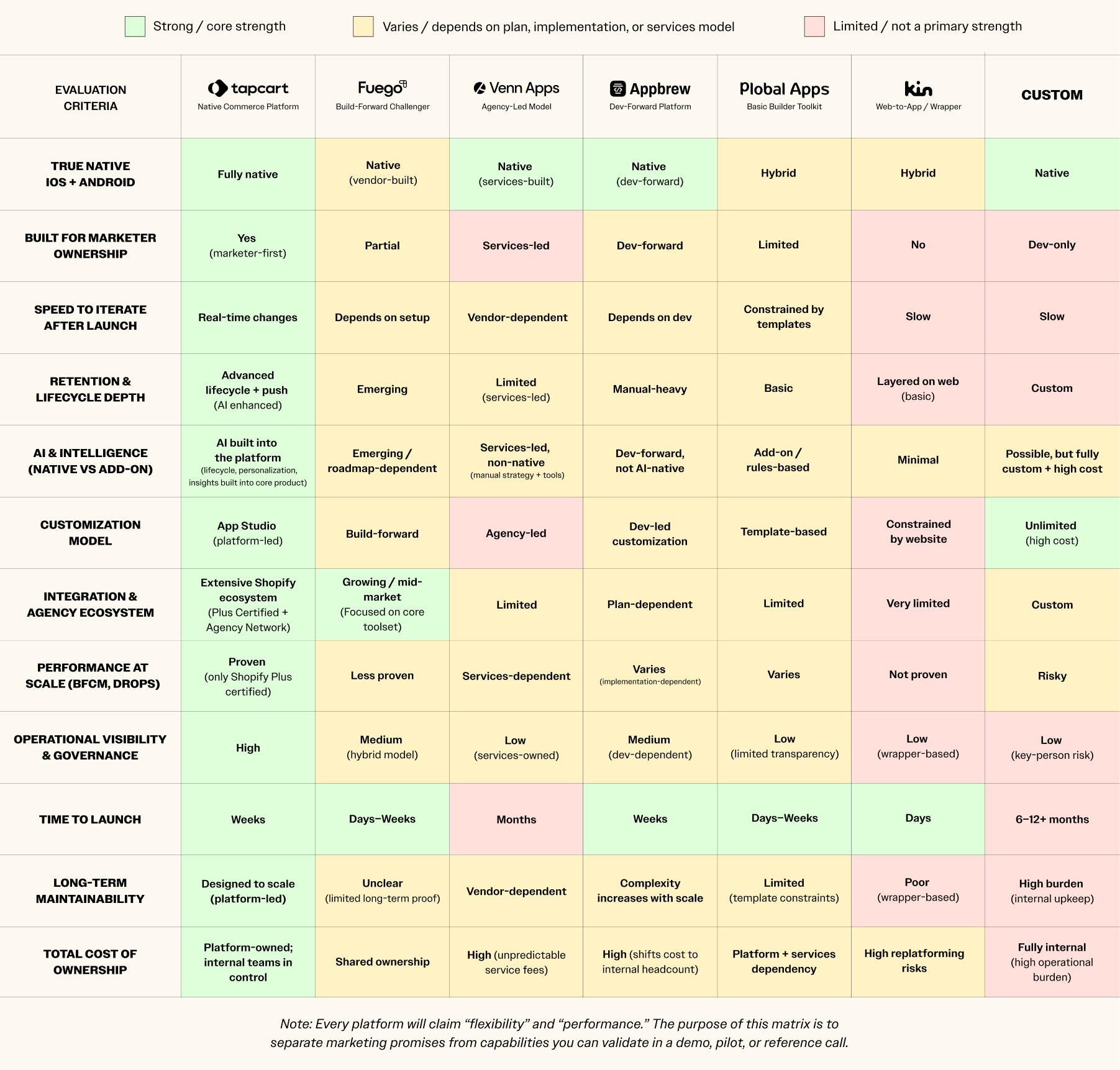
What This Matrix is Designed to Reveal
Most mobile app comparisons stop at surface-level features.
This framework is intentionally different. It’s designed to answer a more important question:
Will this platform help your team move faster over time or will it slow you down as scale, complexity, and expectations increase?
Because in practice, the biggest differences between mobile app platforms don’t show up at launch, they show up months later.
The platforms that win long term are built differently. They combine:
- Native performance tested at scale and maintained during peak moments
- Operator ownership over execution, accelerated by AI that handles the heavy lifting of personalization and campaign building
- Ability to iterate weekly and extensibility without constant custom development
- A mature ecosystem of integration with your tech stack and partners
- Operational models designed for durability, not just launch speed
That’s why Tapcart is built as a native commerce platform — not just a way to “have an app,” but the foundation of a scalable, retention-driven mobile channel that gets stronger as your team and business grow.
Here’s what we consistently see in the market:
The Managed Service Trap (Dependency): Managed or services-heavy models can feel like a white-glove luxury at the start, but they trade away your execution speed. Over time, optimization slows down because your agility is capped by vendor availability, turning quick tweaks into support tickets.
The Build-Forward Trap (Maintenance): Platforms that lead with bespoke, build-it-yourself design promise total freedom, but they carry a hidden expiration date. Iteration eventually stalls because "flexibility through building" creates a permanent maintenance tax on your engineering resources.
The DIY Toolkit Trap (Workload): Builder-style web-wrappers and toolkits often boast low upfront fees, but the real cost is human capital. They give you the tools but force your team to manually configure every feature, shifting the cost to internal labor and QA cycles instead of leveraging platform intelligence.
The True Custom Build Trap (Cadence): Custom-built apps theoretically offer infinite possibilities, but they shift the dependency entirely onto your internal IT team. Maintenance crowds out your roadmap, and cadence collapses as simple merchandising updates get stuck in engineering sprints.
The platforms that win long term are built differently. They combine:
- native performance tested at scale
- operator ownership over execution
- extensibility without constant custom development
- a mature ecosystem of integrations and partners
- operational models designed for durability, not just launch speed
That’s why Tapcart is built as a native commerce platform, not just a way to “have an app,” but the foundation of a scalable, retention-driven mobile channel that gets stronger as your team and business grow.
Even with the right evaluation framework, many brands still fall into common traps when choosing a mobile app platform, often because short-term convenience masks long-term cost. We’ve outlined the most common buyer mistakes to avoid here → [Buyer Traps to Avoid When Choosing a Mobile App Platform].
Choose a Mobile Platform You Won’t Outgrow
Choosing a mobile app platform isn’t about checking boxes or launching fast — it’s about what happens after launch.
As teams scale, expectations rise, and mobile becomes a primary growth channel, the difference between platforms shows up in speed, ownership, and outcomes over time.
See how Tapcart, the first AI-native mobile commerce platform, supports operator ownership, AI-powered retention, and enterprise-scale performance across billions in ecommerce sales.
👉 Request a demo and explore what’s possible with a platform designed for long-term growth.
About the author

Content strategist and creative producer. I'm passionate about learning the latest ecommerce trends and helping brands scale their businesses.





.avif)


